 DeepLightSeek
Compared with the most familiar concepts in geometrical optics, notions within physical optics—such as polarization, birefringence, and optical rotation—often appear more obscure and difficult to grasp. Nevertheless, they have extensive and important applications in engineering. Components commonly used in laser systems, such as polarizers, waveplates, Glan prisms, Faraday rotators, and free-space isolators, are all based on the principles of physical optics. This article explains the fundamentals of polarization, with a particular focus on the working principles and key characteristics of Faraday rotators and free-space isolators.
Introduction to the Basic Principles of Polarization
Polarization
Light is an electromagnetic wave within a certain spectral range. In an electromagnetic wave, the vibration directions of both the electric field intensity E and the magnetic field intensity B are perpendicular to the direction of wave propagation. The photosensitive and physiological effects of light are primarily caused by the electric field intensity E. Therefore, the vibration of E is commonly referred to as the light vibration, and the direction of E vibration is taken as the direction of the light vector.
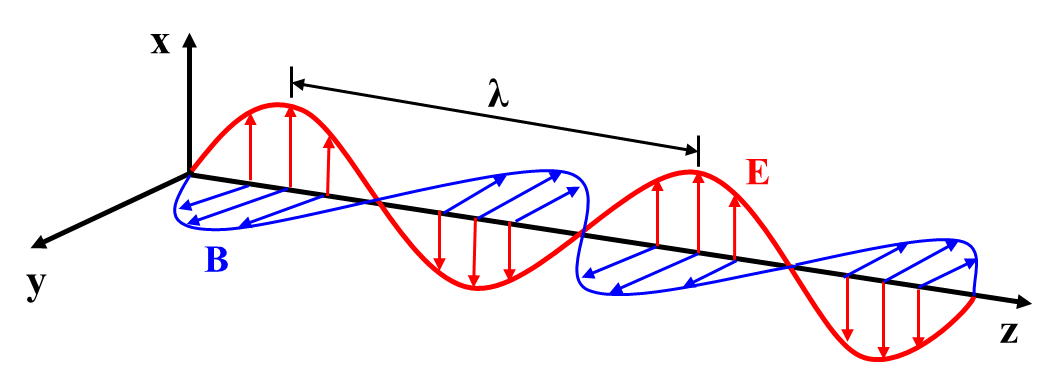
Figure 1. Vibration directions of an electromagnetic wave
In terms of polarization, light can generally be classified into polarized light, natural light, and partially polarized light.
-
Linearly polarized light: During propagation, the direction of the light vector remains unchanged, while its magnitude varies with the phase. In a plane perpendicular to the propagation direction, the trajectory traced by the tip of the light vector is a straight line.
-
Circularly polarized light: The magnitude of the light vector remains constant, while its direction changes regularly. The trajectory of its tip is a circle.
-
Elliptically polarized light: Both the magnitude and direction of the light vector change regularly during propagation. The tip of the light vector traces an elliptical path.
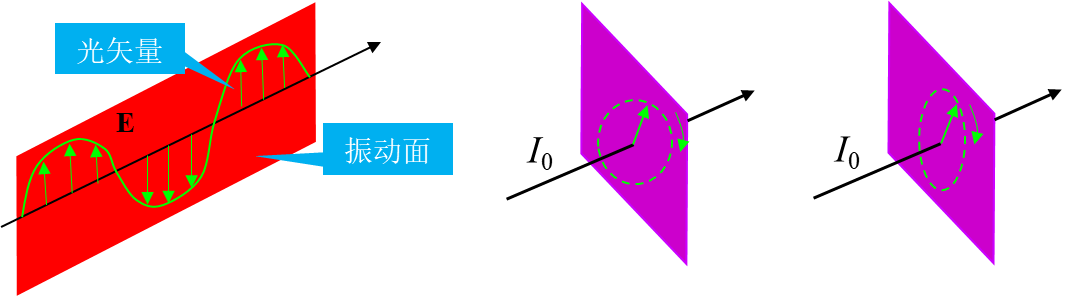
Figure 2. (a) Linearly polarized light (b) Circularly polarized light (c) Elliptically polarized light
Natural light can be regarded as the sum of light waves vibrating in all possible orientations. That is, over an observation period, the probability and magnitude of the light vector vibrating in any direction are equal. When natural light is affected by external influences during propagation, resulting in unequal intensities across different vibration directions, this light is called partially polarized light.
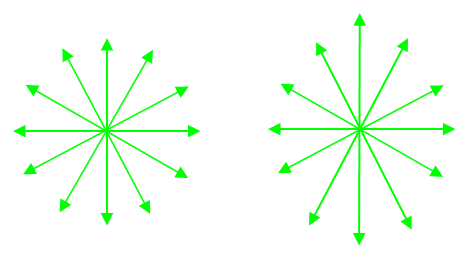
Figure 3. (a) Natural light (b) Partially polarized light
Optical Rotation
For certain crystals, when a parallel beam of linearly polarized light propagates along the optical axis of the crystal, the light vector of the linearly polarized light gradually rotates as the light travels through the material. This phenomenon is called optical rotation.
Substances that can exhibit optical rotation include birefringent crystals (e.g., quartz, tartaric acid), optically isotropic crystals (e.g., sugar crystals, sodium chloride crystals), and liquids (e.g., sugar solution, turpentine).
In intrinsically optically active materials, the direction of light vector rotation depends on the propagation direction of the light. That is, if the light beam returns along the original optical path, its plane of vibration will rotate back to its initial position.
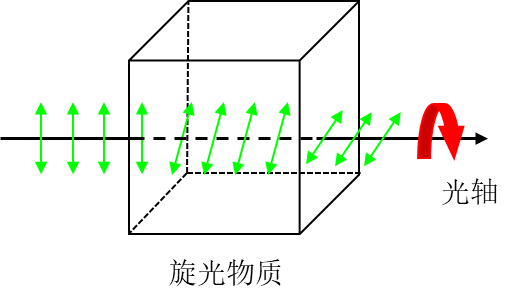
Figure 4. The phenomenon of optical rotation
The Faraday Effect
The Faraday effect, also known as magnetic optical rotation, is a type of magneto-optic effect. A magneto-optic effect refers to the change in the optical properties of a substance under the influence of a strong magnetic field. Specifically, the Faraday effect refers to the phenomenon where a substance that does not inherently exhibit optical activity becomes optically active under a strong magnetic field. That is, the light vector of linearly polarized light rotates as it passes through a material subjected to an external magnetic field.
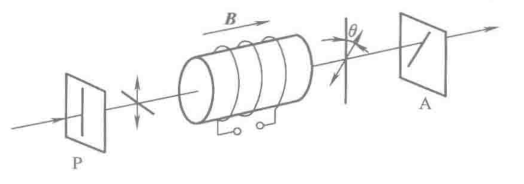
Figure 5. The Faraday effect
As shown in Figure 5, a glass rod is placed inside the magnetic field of a solenoid and positioned between crossed polarizers P and A. When the light beam passes through the glass sample along the direction of the magnetic field, the analyzer A can receive the light transmitted through the sample. The rotation angle θ of the incident light vector is proportional to the magnetic flux density B acting on the non-magnetic substance along the light propagation direction and the thickness l of the substance through which the light passes, expressed as:
θ = VBl
Here, V is a material constant known as the Verdet constant. It is wavelength-dependent and very close to the absorption resonances of the material; therefore, different materials should be selected for different wavelengths.
From the perspective of polarization properties, the rotation of the light polarization direction caused by a magneto-optic material depends solely on the direction of the applied magnetic field and is independent of the light's propagation direction. This means it can rotate the polarization plane of both forward and backward incident light by the same angle in the same direction, regardless of the transmission direction. Consequently, the Faraday effect exhibits non-reciprocity, which differs from the intrinsic optical rotation of materials.
Working Principles of Polarization Devices
There are many commonly used polarization devices. In our previous technical article series, we have introduced components such as polarizing beam splitter cubes and waveplates. This article focuses on two specific polarization devices: the Faraday rotator and the free-space isolator.
Faraday Rotator
A Faraday rotator is a device that utilizes the Faraday effect to rotate the polarization state of light, typically producing a 45° rotation for a specific wavelength under a saturating magnetic field. It consists mainly of a magneto-optic material and a permanent magnet. The working principle is illustrated in Figure 5 above.
-
Common magneto-optic materials for the visible and near-infrared spectrum: Yttrium iron garnet (YIG crystal), terbium gallium garnet (TGG crystal), terbium-doped glass, and bismuth (Bi)-doped garnet crystals, among others.
-
Magnetic field required for the magneto-optic rotation effect: This is typically supplied by permanent magnets. The magnet must generate the strongest possible axial magnetic field within the space occupied by the magneto-optic material, enabling the material to produce a large and stable polarization rotation angle. Common permanent magnet materials include samarium-cobalt (Sm-Co) and neodymium-iron-boron (NdFeB).
Free-Space Isolator
A free-space isolator is a non-reciprocal optical element created using the Faraday effect. It permits light to travel in only one forward direction while blocking backward propagation. It mainly consists of a polarizer (plate), a Faraday rotator plate, a magnetic ring, and metal housing components. In the optical path, a single-stage free-space isolator commonly adopts a three-part structure: "polarizer–rotator plate–polarizer." Its working principle is shown in Figure 7.

*Figure 7. Working principle of a free-space isolator*
As shown in Figure 7(a), P and A are polarizers whose transmission axes are oriented at a 45° angle to each other. F-R is the rotator plate. The light vector of linearly polarized light is rotated by 45° after passing through the rotator plate. At this stage, light propagating from left to right can pass through A and exit. For backward-propagating light traveling from right to left, after passing through A and the rotator plate F-R, since the magnitude and direction of the magnetic field remain unchanged, the vibration direction of the light vector is again rotated in the same direction by another 45°. This makes it exactly perpendicular to the transmission axis of polarizer P (see Figure 7(b)), thus completely blocking it from passing through P. The backward-transmitted light is stopped.
Key Specifications for Polarization Devices
Faraday rotators and free-space isolators are primarily used in laser systems. Like common laser mirrors, laser lenses, and other optical components, selecting the right product requires attention to parameters such as laser-induced damage threshold, maximum optical power handling, transmittance, and attenuation. In particular, two important optical specifications for free-space isolators deserve special attention: insertion loss and isolation.
Insertion Loss
The insertion loss of an optical isolator is the ratio of the output optical power to the input optical power when the isolator is connected in the forward direction, expressed in dB. Assuming the forward input optical power is P₁_forward and the forward output optical power is P₂_forward, the insertion loss formula is:
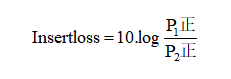
Factors affecting insertion loss include the intrinsic absorption of the materials, return loss at each end-face, angular errors between the birefringent crystal and the Faraday rotator, extinction ratio, and lens coupling loss, among others.
Isolation
Reverse isolation is one of the most critical specifications for an optical isolator. It characterizes the isolator's ability to attenuate light traveling in the reverse direction. When the isolator is connected in reverse, let the reverse input optical power be P₁_reverse and the reverse output optical power be P₂_reverse. The isolation formula is:
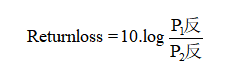
The main factors influencing isolation include the angular error in the magneto-optic crystal's rotation, the crystal's extinction ratio, and the impact of reflections from various surfaces. Currently, single-stage optical isolators typically achieve an isolation of greater than 30 dB. Dual-stage isolators (using a "polarizer–rotator–polarizer–rotator–polarizer" structure) can achieve even higher isolation.
Product Introduction for Polarization Devices
Guangtan Intelligent Technology has launched Faraday rotators and free-space isolators for wavelengths of 532 nm and 1064 nm. These products feature advantages such as high power handling, high transmittance, and a high laser-induced damage threshold. Product details are presented in the table below. We also provide customized services for these components.
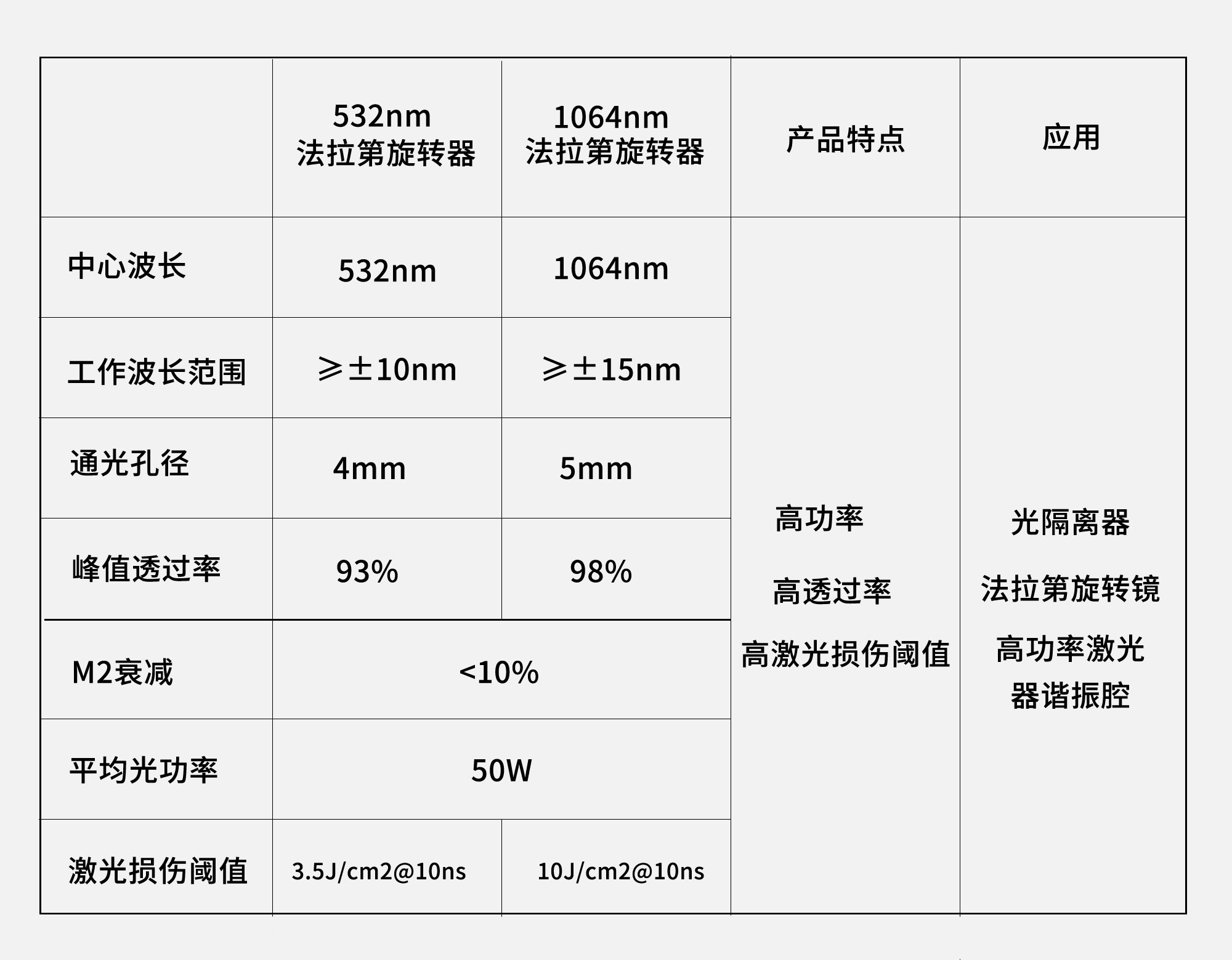
Faraday Rotators
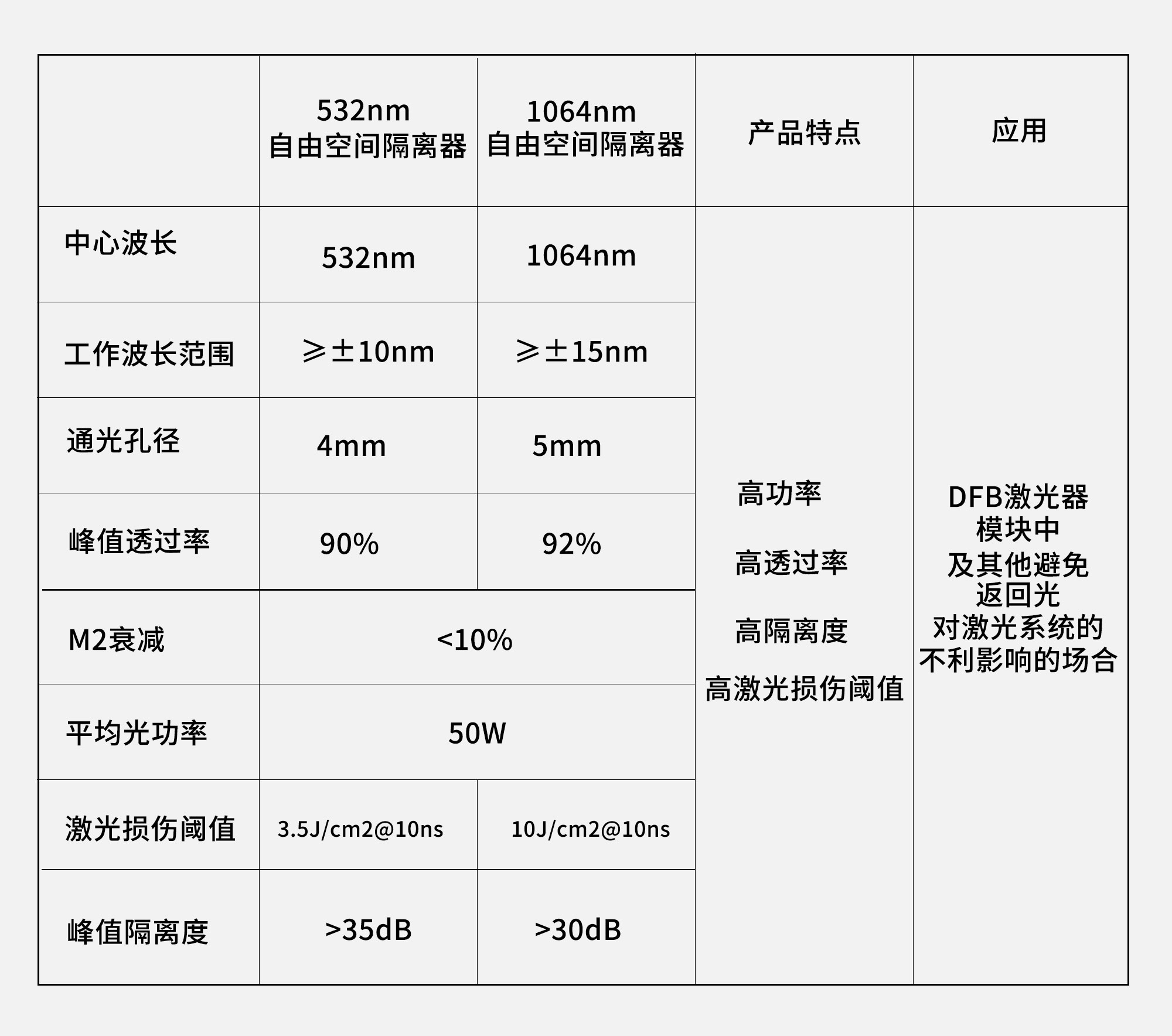
Free-Space Isolators
