 DeepLightSeek
definition:
For optical resonators with dynamically unstable lateral beam displacement.
According to the design details, optical resonators are either stable or unstable for lateral beam offset. If the resonant cavity is stable, any geometric rays with lateral displacement or angle that are not too large will remain in the system and move back and forth. For unstable resonant cavities, this light will eventually exit.
The properties of resonant cavity modes vary greatly between stable and unstable conditions. Unstable resonant cavities have some special properties:
- Patterns typically have strong diffraction losses (with each round trip being...)50%Or higher).
- The diffraction loss of higher-order modes is higher. This intrinsic pattern recognition makes it easier to achieve single lateral mode operation of lasers.
- Especially in the diffraction case at the hard edge of the resonant cavity, the transverse mode cross-section is very complex and usually has a ring-shaped structure. At this point, only numerical methods can be used to calculate the cross-section of the model. In some resonant cavities with soft apertures (as shown below), their mode properties can be estimated through analytical methods.
- In a linear unstable resonant cavity, the wavefronts of the two opposing beams do not coincide with each other, and therefore do not match the surfaces of the two end mirrors.
Instability does not mean that this resonant cavity is less robust than a stable resonant cavity. On the contrary, the alignment sensitivity of unstable resonant cavities is lower than that of stable resonant cavities, and the use of unstable resonant cavities has achieved very robust high-power lasers.
Output coupling of unstable laser resonant cavity
Usually, the diffraction loss of unstable laser resonators is used as a useful laser output. The output coupler is a common laser mirror, in which the field distribution exceeds the edge of the mirror, so some light can pass through the mirror and exit (as shown in the figure)one). Although there is a hole in the near-field region of the output beam cross-section, the beam divergence angle is very small. Therefore, the beam quality of this very high-power laser using an unstable resonant cavity is higher than that using a stable resonant cavity, especially when the diffraction loss is large and the hole is very small.
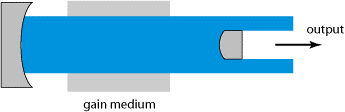
pictureoneUnstable laser resonant cavity with output coupling at the hard edge reflector.
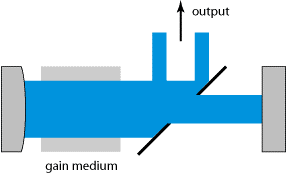
picturetwoUnstable laser resonant cavity with output coupling at the scraper mirror. If a scraper mirror is used (as shown in the figure)twoA slanted mirror with elliptical holes, which can“scrape off”Some beams of light moving back and forth inside the cavity.
Additionally, a variable reflectivity mirror can be used, where the reflectivity decreases as the distance from the beam axis increases, usually according to Gaussian or hyper Gaussian equations. This scheme can avoid the circular structure of the typical near-field output beam cross-section and is usually suitable for obtaining high-quality beams.
Sometimes, a resonant cavity is stable in one direction and unstable in the other direction. This hybrid resonant cavity is typically used in beams with high ellipticity.
Advantages and limitations of unstable laser resonators
Most laser resonators are stable, but unstable resonators have significant advantages in certain situations. Especially, it can obtain a very high-power laser beam with high beam quality. The common problem with stabilizing a resonant cavity in this situation is the inability to achieve a sufficiently large fundamental resonant cavity mode, or the sensitivity of this mode to thermal lenses and misalignment. The unstable resonant cavity fundamental mode accounts for a large proportion, and the net gain is much greater than that of high-order modes. In addition, it is not sensitive to misalignment. However, this principle only applies when the gain medium can provide sufficient gain. In pulse flash or diode pumpingYAGThis is the case in metal gas lasers, excimer lasers, and chemical lasers. However, applying it to low gain lasers, such as carbon dioxide lasers or continuous wave lamp pumped solid-state lasers, can be challenging and typically results in low beam quality.
