 DeepLightSeek
definition:
Optical polarizer obtained by using multi-layer dielectric coating.
Thin film polarizer is a type of optical polarizer that utilizes the interference effect of multi-layer dielectric coatings. Coatings are usually placed on glass sheets. (No need to use birefringent materials.) At certain incident angles, the reflectivity can be obtained as a function of polarization. (Usually using)sPolarized light is reflected, andpPolarized light is transmitted. )The incident angle of a commonly designed thin film polarizer during operation is45°At this point, the angle of the reflected beam changes compared to the incident beam90°
There are different types of thin film polarizers:
- A sheet-like polarizer consisting of only one layer of coated glass sheet. Usually, the incident angle is designed as the Brewster angle, which can avoid the reflection loss of backward transmitted light. If the incident angle is at another angle, for example45°(Most commonly), an anti reflective coating is required on the back, and the structure of the front design layer is also relatively difficult.
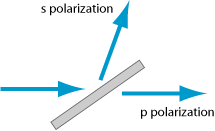
pictureoneA sheet-like polarizer working near the Brewster angle, with a reflective coating on the top and no coating on the bottom.
- Polarization cube is usually used for45° Prism coating, then apply another one45° Prisms are glued onto it, resulting in a cubic structure. The incident and exit surfaces are usually coated with anti reflective coatings. commonly usedMacNeilleThe basic principle of cube design is to eliminate the Brewster angle of incidence on all incident surfacespPolarization reflection. Therefore, introducing Bragg reflectors is easy to obtainsPolarized high reflectivity and no introduction of impuritiespPolarization reflection. The Brewster angle condition requires that the refractive index of the substrate material is appropriate (given the coating material). This type of polarizer is suitable for a wide wavelength range, but the incident angle range is relatively narrow (a few degrees).
In other polarized cube structures, the Brewster angle condition may not be satisfied, and interference effects can be used to suppress itpPolarization reflection. This type of interference polarizer only works in a very narrow wavelength range, but materials can be flexibly selected.
The adhesive surface in the polarized cube reduces the optical damage threshold under nanolaser pulse conditions to1 J/cm2 The magnitude. Polarization cubes that do not require adhesive optical contact can withstand higher strength.
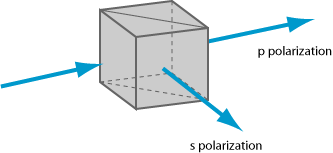
picturetwoAdhesive of two by thin film coating45° Polarization cube obtained by prism. Due to the polarization dependent interference effect between multi-layer coatings, thin film polarizers can only operate within a limited range of wavelengths and angles. By optimizing the film design, the working wavelength can reach a range of several hundred nanometers. However, this broadband polarizer cannot achieve the performance of narrowband polarizer (laser linear polarizer). picturethreeProvided a working bandwidth of50nmThe reflectivity curve of the polarizer.
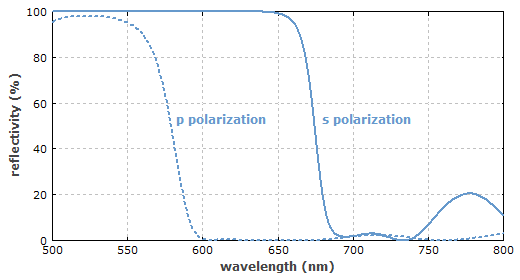
picturethree: AdoptingTiO2/SiO2The reflectivity of a thin film polarized cube, working in600-650nmWithin the scope.
To optimize the coating of thin film polarizers, similar numerical simulation techniques can be used to design broadband beam splitters or dichroic mirrors.
The advantage of thin film polarizers is that they can be made in very large sizes, while using crystal (birefringent) polarizers is very difficult. Therefore, it can work in high-power or high-energy laser pulse devices.
