 DeepLightSeek
Definition:
A device that can reflect light.
A device that can reflect light.
A mirror is an optical device capable of reflecting light. However, strictly speaking, an optical device is only called a mirror if the angle of incidence equals the angle of reflection (as shown in Fig. 1). This implies that devices like diffraction gratings are not referred to as mirrors, even though they can reflect light.
The surface of a mirror is not necessarily flat; curved mirrors also exist.
The surface of a mirror is not necessarily flat; curved mirrors also exist.
Properties of Mirrors
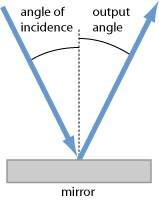
Fig. 1: Reflection of light by a mirror.
Mirrors possess several fundamental properties:
Mirrors possess several fundamental properties:
- Reflectivity (or Reflectance): This is the percentage of reflected optical power. It generally depends on the wavelength, the angle of incidence, and the direction of polarization.
- Reflection phase: This is the phase shift of the reflected light, i.e., the change in optical phase upon reflection. The phase shift depends on the wavelength and the polarization direction. If the phase changes differ for s- and p-polarization (at non-normal incidence), the polarization state of the incident light will be altered upon reflection, even if the incident light is purely s- or p-polarized.
- Spectral range: Mirrors only operate within a limited wavelength range, and the desired reflectivity is achieved only within this region. The width of this region is called the reflection bandwidth. The bandwidth value depends on the angle of incidence, the polarization state, and the reflectivity tolerance.
- Angle of incidence range: The range of acceptable angles of incidence is also limited, especially for dielectric mirrors.
In many applications, several other properties must be considered:
- Surface quality: In laser technology, very high surface quality is required. Surface smoothness is usually specified in terms of wavelengths, for example, λ/10. Since surface defects are largely a random phenomenon, only a statistical characterization can be given. For small local defects, the "scratch and dig" specification is commonly used. This includes the maximum length of scratches (in tenths of a micrometer) and the maximum diameter of digs (in hundredths of a micrometer). For example, a scratch-dig value of 20-10 indicates a maximum scratch length of 2 μm and a maximum dig diameter of 0.1 μm.
- Optical damage threshold: When using high-power lasers, the optical damage threshold must be considered, especially for pulsed lasers due to their high peak powers.
Types of Mirrors
Metallic Mirrors
Common household mirrors are silver mirrors. They are made from a metal plate with a silver coating applied to one side. The coating is thick enough to suppress light transmission to both sides. However, the reflectivity is less than 100% because the silver coating absorbs a portion of the light. The coating of a household mirror is usually on the inside, with a glass surface on the outside, making it easy to clean. In other applications, light is typically incident directly onto the coating, without passing through a substrate.
Common household mirrors are silver mirrors. They are made from a metal plate with a silver coating applied to one side. The coating is thick enough to suppress light transmission to both sides. However, the reflectivity is less than 100% because the silver coating absorbs a portion of the light. The coating of a household mirror is usually on the inside, with a glass surface on the outside, making it easy to clean. In other applications, light is typically incident directly onto the coating, without passing through a substrate.
In laser technology and basic optics, more advanced metallic mirrors are used. These mirrors usually have additional coatings on the surface to enhance reflectivity and protect the metallic coating from oxidation. Various metals can be used for mirror coatings, such as gold, silver, copper, and nichrome.
See the article on Metallic Mirrors for more details.
See the article on Metallic Mirrors for more details.
Dielectric Mirrors
The most important mirrors in laser technology and basic optics are dielectric mirrors. These mirrors consist of multiple thin layers of dielectric coatings. They utilize the combined effect of reflections at the interfaces of different layers. A common type is the Bragg mirror (or quarter-wave mirror), which is the simplest type of mirror capable of achieving the highest reflectivity at a specific wavelength (the Bragg wavelength).
Refer to the article on Dielectric Mirrors for more details.
Laser mirrors used to form laser resonators are typically dielectric mirrors with very high optical quality and a high optical damage threshold. There are also supermirrors, which have reflectivities very close to 100%, and chirped mirrors, which have thin films with systematically varying thickness.
The most important mirrors in laser technology and basic optics are dielectric mirrors. These mirrors consist of multiple thin layers of dielectric coatings. They utilize the combined effect of reflections at the interfaces of different layers. A common type is the Bragg mirror (or quarter-wave mirror), which is the simplest type of mirror capable of achieving the highest reflectivity at a specific wavelength (the Bragg wavelength).
Refer to the article on Dielectric Mirrors for more details.
Laser mirrors used to form laser resonators are typically dielectric mirrors with very high optical quality and a high optical damage threshold. There are also supermirrors, which have reflectivities very close to 100%, and chirped mirrors, which have thin films with systematically varying thickness.
Curved Mirrors
Most curved mirrors have spherical surfaces, characterized by a radius of curvature R. Concave mirrors act as focusing mirrors, while convex mirrors exhibit defocusing behavior. Apart from changing the beam direction, these mirrors act somewhat like lenses. At normal incidence, the focal length is R/2, i.e., half the radius of curvature. For non-normal incidence at an angle θ, the focal length is (R/2) • cos θ in the tangential plane and (R/2) / cos θ in the sagittal plane.
Most curved mirrors have spherical surfaces, characterized by a radius of curvature R. Concave mirrors act as focusing mirrors, while convex mirrors exhibit defocusing behavior. Apart from changing the beam direction, these mirrors act somewhat like lenses. At normal incidence, the focal length is R/2, i.e., half the radius of curvature. For non-normal incidence at an angle θ, the focal length is (R/2) • cos θ in the tangential plane and (R/2) / cos θ in the sagittal plane.
There are also parabolic mirrors, whose surfaces are parabolic. For tight focusing, off-axis parabolic mirrors are often used, which produce a focal point outside the path of the incident beam.
Dichroic Mirrors
Dichroic mirrors exhibit completely different reflection characteristics for two different wavelengths. They are typically thin-film dielectric mirrors designed specifically for this purpose.
Dichroic mirrors exhibit completely different reflection characteristics for two different wavelengths. They are typically thin-film dielectric mirrors designed specifically for this purpose.
